
Meet Bundibugyo – Ebola’s Understudied Relative
With Ebola virus cases soaring in Central and East Africa, the understudied virus at its center presents a challenge to treatment.
As the summer progresses, cases of Ebola virus continue to soar in the Democratic Republic of the Congo (DRC) and Uganda. With over 3500 cases to date and over 1500 deaths, this is the fastest growing outbreak of Ebola to date and stands as the third largest in the virus’s recorded history. Public health officials are scrambling to control the outbreak, but one of the several impediments to stopping the spread lies within the virus itself.
The causative agent of this outbreak is a strain of Ebola virus known as Bundibugyo, the most recently identified of the five Ebola strains. First isolated in 2007, Bundibugyo virus has only caused two documented outbreaks – one in 2007 with 131 cases and another in 2012 with 62 cases. Compared to other types of Ebola virus such as the Zaire or Sudan strains, which have caused over 30 outbreaks since 1976, Bundibugyo virus remains understudied due to its lower rate of outbreaks.
Now, with the largest Bundibugyo virus outbreak on record, health professionals must grapple with the fact that there are no licensed Bundibugyo virus treatments. However, scientists are working to develop and license drugs that can not only target Bundibugyo virus, but also function across other Ebola virus strains to help mitigate future outbreaks.
Existing strategies: targeting the glycoprotein
Ebola virus is transmitted through contaminated bodily fluids from an infected person, such as blood or vomit. Once the spaghetti-shaped virus particles enter a new host, its proteins attach to a cell’s surface and invade, turning the cell into a virus-producing factory. These surface proteins are known as glycoproteins, akin to the coronavirus “spike” discussed during the COVID-19 pandemic, and these surface glycoproteins pose a valuable target for antiviral therapies.
The disease caused by Ebola virus–ranging from fever and muscle pain to vomiting and severe bleeding–is primarily treated using antibodies designed to target these viral glycoproteins, thereby stopping the virus from entering a cell. The approved drugs of choice to date are known as Ebanga and Inmazeb, the former consisting of a single antibody while the latter is a mixture—or cocktail—of three antibodies. These antibodies were discovered and developed to bind to the surface glycoprotein of the Zaire strain as a therapeutic against the disease. However, these drugs have not yet been approved for other Ebola virus strains such as Sudan and Bundibugyo, where the current treatment strategy is simply supportive care such as IV hydration and pain management.
Other previous attempts to stall the spread of Ebola outbreaks have used a vaccine, which is also only approved for the Zaire strain. This live, replicating vaccine relies on an animal virus known as vesicular stomatitis virus (VSV) which has been modified to contain only the glycoprotein of the Ebola Zaire virus. When inside the body, the chimeric—or mixed—virus replicates but does not cause disease, exposing the immune system to non-pathogenic Ebola glycoprotein. Antibodies against this surface protein are quickly produced in the body such that the immune system is primed in the case of a real Ebola virus infection.
However, to date, these antibody-based therapeutics and the VSV vaccine have not been licensed for any strain other than Zaire, meaning they will be ineffective against the current Bundibugyo outbreak. As such, efforts are underway to approve drugs and vaccines targeting other Ebola strains to help in current and future outbreaks.
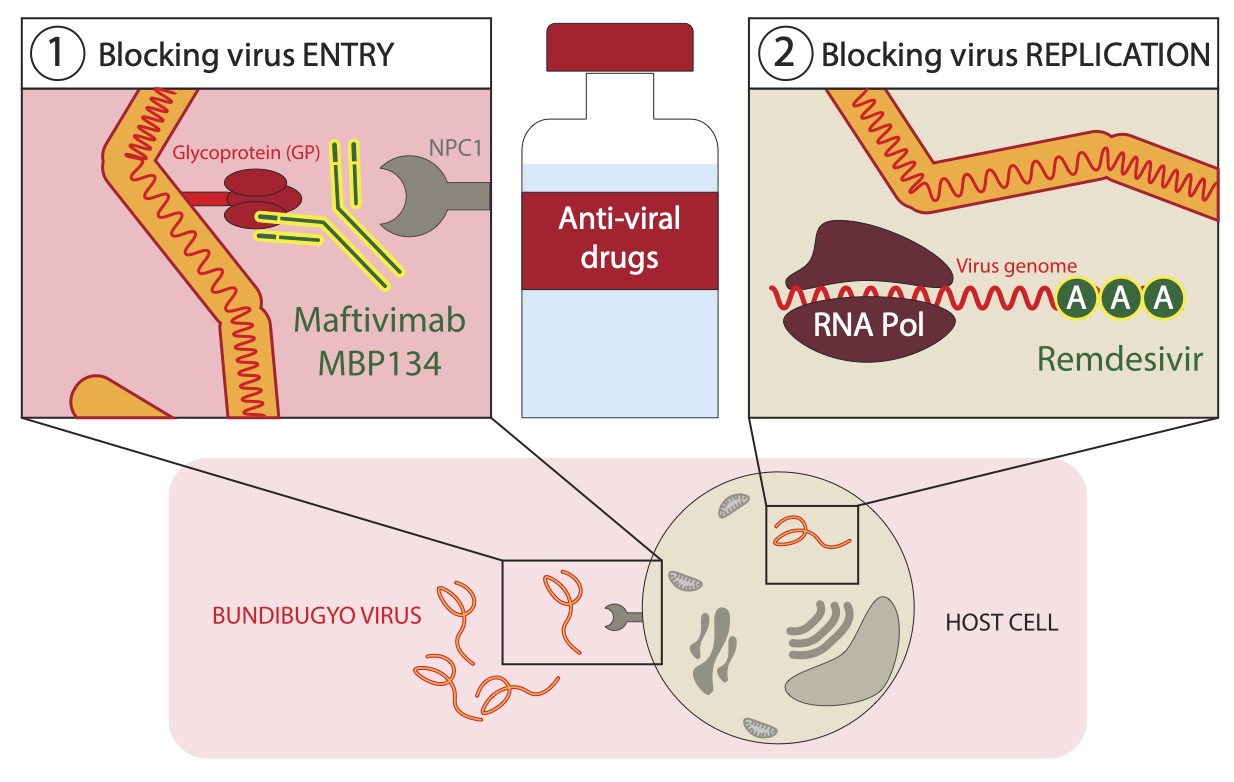
Figure 1| New drug candidates in clinical trials to combat Bundibugyo virus currently include GP-specific monoclonal antibody maftivimab, and an antibody-drug cocktail of MBP134/Remdesivir. Image credit: Ankita Chopde.
New drug candidates and their upcoming clinical trials
To combat the Bundibugyo outbreak, new therapeutics have recently been developed and selected for clinical trials. These candidate drugs are based on existing treatments, such as the antibody-based drugs mentioned previously, and have shown promise in preliminary studies.
The previously discussed licensed antibody cocktail against Zaire Ebola virus, Inmazeb, contains three antibodies, one of which—known as maftivimab—has been expedited into clinical trials for use against Bundibugyo. Another antibody-based therapy, MBP134, is a top candidate for handling Ebola outbreaks regardless of strain. Composed of two antibodies isolated from survivors of Ebola, MBP134 has been shown to protect non-human primates against the Zaire, Sudan, and Bundibugyo strains and is currently beginning clinical trials along with another well-researched drug.
During the COVID-19 pandemic, the drug remdesivir emerged as a treatment for hospitalized individuals. It functions by interrupting the virus’s genome replication, thereby stopping the viral life cycle and halting infection in its tracks. This mechanism of action makes remdesivir widely applicable for a broad class of viruses that encompasses SARS-CoV-2 (the virus that causes COVID-19) and Ebola. As such, remdesivir is currently undergoing clinical trial alongside MBP134, with the hope of providing a dual-approach treatment against infection with any of the pathogenic Ebola viruses. If it successfully completes clinical trials, this drug duo may help mitigate further Ebola outbreaks..
Upcoming vaccines, more clinical trials
While therapeutic drugs are aimed at mitigating the effects of the virus after exposure, controlling the outbreak will require preventative approaches as well. While it is unlikely that a Bundibugyo-specific vaccine will finish clinical testing in time for use in this current outbreak, clinical trials are underway or in preparation for three new vaccine candidates, each with slightly different approaches.
Similar to the aforementioned approved Zaire Ebola VSV-based vaccine, one vaccine expresses the Bundibugyo glycoprotein on the surface of replicating VSV. Another related approach comes out of the Oxford Vaccine Group and relies on the same principle as the AstraZeneca COVID-19 vaccine. By expressing the Bundibugyo glycoprotein on the surface of a different kind of virus called an adenovirus, the immune system will similarly learn to recognize the signature molecular markers, known as epitopes, of the Bundibugyo protein. In contrast to the replication-competent VSV vaccine, the adenovirus is unable to replicate and produce more copies of itself, adding to the safety of the vaccine. One last vaccine candidate soon to be in trial uses the mRNA platform that came into the public lens during the COVID-19 pandemic, where the RNA sequence used to make the SARS-CoV-2 glycoprotein, or its spike, was given as a vaccine. This time, the RNA sequence encoding for the Bundibugyo virus glycoprotein would be administered, giving the body instructions to make only the glycoprotein and allowing the immune system to begin recognizing this protein by making antibodies. All three vaccine candidates rely on the immune system developing antibodies against the Bundibugyo glycoprotein, which allows for rapid immune protection in the event of a real infection.
As vaccines become approved, they will likely be administered to potential contacts and neighboring communities to prevent further spread of this highly pathogenic virus. Underlying any distribution of preventative measures or treatments, however, are barriers to implementation and scientific development that must be addressed.
For the next time
The COVID-19 pandemic not only brought forth countless scientific improvements in vaccines and antiviral drugs that we carry forward to other epidemics, but it highlighted the obstacles impeding mitigation of disease outbreaks. Ebola outbreaks grow due to slow response times from health officials, inadequate support and trust in medical infrastructure, and a lack of proper testing and surveillance practices—conditions which global health organizations must continue trying to remedy.
The rarity of Bundibugyo virus is another core reason for the scale of this current outbreak, owing to the lack of approved treatments against this particular strain. However, constant scientific progress on understudied or emerging viruses ultimately allowed for the development of these drug and vaccine candidates. This will likely save countless lives across new Ebola virus outbreaks, underpinning the need for continued efforts to understand emerging viral diseases. With continued scientific progress, an efficient but rigorous clinical trial system, and prioritization of global public health resources and response, it is possible that the tide of runaway Ebola virus outbreaks will turn.