
Dr. Aaron Schmidt, PhD
“Where did viruses come from? Where did they originate, and how did they help shape our evolution?”
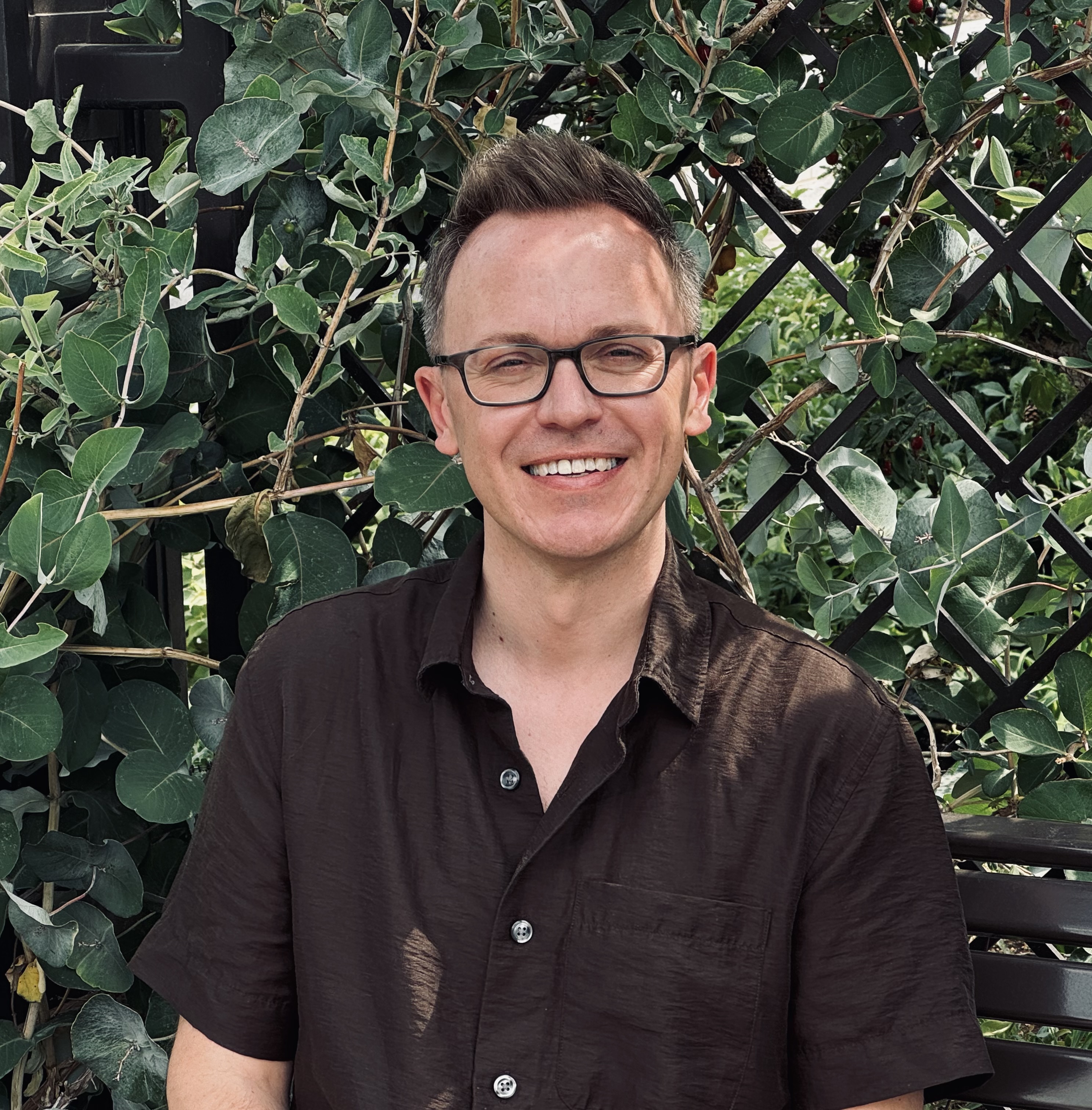
If someone were to hand Dr. Aaron Schmidt the answer to just one mystery in virology, it would be to know the origin of viruses. This fascination with life's biggest unknowns has shaped their career, from studying dengue virus entry during their PhD, to how the adaptive immune system evolves alongside RNA viruses in their lab at the Ragon Institute of Mass General Brigham, MIT, and Harvard. Beneath the science, however, is a person just as likely to talk about Broadway, cross-stitching, and sarcastic lab banter as they are about viral evolution.
We recently sat down with Aaron to talk about curiosity, mentorship, lab culture, and the questions that continue to inspire their work.
Q. If we opened a time capsule from your childhood, what would we find that hinted you'd become a scientist?

Outbreak (1996) VHS
The very first item you would see would absolutely be a VHS of the movie Outbreak (1995). It starred Dustin Hoffman and was about an Ebola outbreak. This was before I knew about diseases and infections, and the movie really highlighted viruses, particularly these hemorrhagic fever viruses. ‘Outbreak’ was one of the first movies that really got me interested in viruses.
Watching NOVA and spending time at the library
We also didn’t have cable growing up – that was not allowed in my household. So, we either had the choice of reading or watching PBS! NOVA on PBS was my go-to. Here, I was exposed not just to viruses but to science in general. And my favorite place to go was the library – I was always asking my parents to take me there! I enjoyed reading, of course, fiction, but also science-related books. I read a wide variety – from astronomy, to physics, to chemistry – so it wasn’t just one niche area, but science broadly that I was interested in.
A copy of Rachel Carson’s Silent Spring
All along the way, I had very pivotal, inspirational science teachers growing up. When I was in grade school, we had an assigned reading – Rachel Carson’s Silent Spring, a monumental book about the use of pesticides. This book, alongside my seventh-grade science teacher Mrs. Magnuson, were instrumental in cultivating my interest in science.
Q. If someone met you at a coffee shop and asked you ‘What does your lab do?’, how would you answer?
I often try to remain general and say I work on viruses (as you know, head of the program!). If they were to then ask ‘Oh, what viruses?’, then I would say influenza, flaviviruses – and most people don’t know what flaviviruses are, so I’d say dengue, or West Nile virus.
But honestly, I try to keep my answer to this question pretty simple and will default to saying I work on vaccines. While that’s not entirely accurate…it is an easy way to get out of conversation…
(Ahem) So overall, I’d say I teach, and my lab works on developing vaccines or therapeutics against viruses that are potentially ‘pandemic-causing’.
Q. Imagine a brand-new graduate student joins your lab tomorrow. What's one thing you hope they learn from you that has nothing to do with virology?
-Long pause-
Probably…how to remain excited about science when the difficult, hard days come, especially in graduate school. Because during a PhD, there are wins – and by wins, I mean a successful PCR reaction, a good protein purification, an amazing recombinant protein expression, or a crystal structure etc – but those wins can be very far and few between in a sea of losses. I think one of the things I try to do is to encourage students to remain excited by the science. There will be lows, but you can often learn from those lows. In my experience, it’s often the experiments that don’t work that are the most illuminating on the underlying biology of the questions you’re asking. And yes, it is always great when you go in with a hypothesis and your hypothesis is proven correct on the first experiment, but that is (laughs) never the case! It’s those disappointing negative results that end up steering you in the direction of the often more exciting science.
Q. If your lab had a personality, how would you describe it?
Sarcastic. Without fail. I can (maybe to a fault), be a little too sarcastic at times, and so I do appreciate that the people who gravitate towards my lab – and are of course, amazing, brilliant scientists – but are certainly more on the biting, sarcastic side! The people in my lab all follow the mantra of ‘we’re here to have a good time, do good science, and be a little bit witty and sarcastic’.
Q. Say everyone in your lab has to spend a day doing what you do to unwind after work. What are they in for?
I love movies – I go to the movies every Sunday! I will watch literally anything (except for animated films, just a personal preference). Whether it’s at the movie theatre or at home, that is certainly something I do to unwind. Reading is another thing; so, I try to have an hour every night while unwinding to read a book.
I also cross-stitch; which comes across as surprising to some! All the things I’ve mentioned are activities in which your mind needs to focus on something else, as opposed to thinking about the science, or the day, or the administrative side of things. It’s that forced separation that really helps me unwind from a long day at work.
If my lab were to shadow me on an unwinding day – I would be very curious (laughs) to see some of them cross-stitch! Maybe the next lab meeting could be learning how to cross-stitch.
Q. In an alternate universe where science doesn't exist as a career, what would you be doing?
Theatre. Hands down. Without a question. When I was in high school, deciding where to go to college and what to major in, it truly was a fork in the road. Alternatively, I wanted to go to college to do science (I aspired to go to medical school, an MD-PhD), and to be honest PhD was never really on my radar. It was medical school or theatre. I was very heavily involved in theatre in high school, and it was something I thought was told I was good at? And I was encouraged to go to a conservatory, or a theatre-magnet college. So, choosing science over theatre was a very, very difficult decision for me. I don’t regret my choices; I try not to have any regrets in my life. Certainly, my path would have been very different – in fact, we would not be having this conversation right now if I had chosen the other option. I would have loved going to Broadway and performing, and if that hadn’t worked out, then becoming a high school theatre teacher would definitely have been in my future.
Some of my fondest memories are being a part of theatre in high school; even after, into college and graduate school. (Interviewer: into graduate school? Wow, how did you continue your love for theatre during the busy and hectic PhD life?) (laughs) In my third or fourth year of graduate school, I was in a production at the A.R.T. in Cambridge, it was called ‘Bent’! Harvard Crimson published an article on it too (linked). Bent is playwright Martin Sherman’s best-known work, a story circling three homosexual men in Berlin during World War II. I played Rudy, one of the main characters in the first act. This was an undergraduate senior’s theatre project – her name was Rachel - so very impressive! Rachel had an open casting, for anyone affiliated with Harvard, and I just went and auditioned for it. Now that I think about it, I have no clue how I even heard about it! I must have been on main campus and seen a flyer around or something. It was one of the best experiences that I had; it was an amazing group of people.
Q. That’s so cool! A lot of people think graduate school is all about work, but you seemed to have found other ways to create amazing memories while doing cool science. What advice do you have for graduate students on ‘having a life outside of lab’?
The primary focus (write this down, Ankita) of graduate school should be science and working on your thesis and…(laughs) no, no cut that out. It’s good to remember that you’re not just the science you do, you are individuals that are rounded out by the experiences that you partake in outside of the lab, too. I know people in my own lab who do ceramics, or are runners, and other hobbies. There are many dimensions to each individual, and that should absolutely be celebrated in their journey all throughout graduate school. It’s tough, graduate school. You need to find ways to both remain excited by the science but also excited about life in general. I will continue encouraging students in our program, and in my own lab, to pursue things that interest them and excite them!
Q. If you could leave one note for yourself on your very first day of graduate school, what would it say?
(-Another long pause – “oh gosh…”)
The phrases that are coming to mind are ‘Be happy, it’s worth it’, but I think the phrase that I’ll center on is ‘Don’t take yourself too seriously’. I don’t know if that’s good advice or not; for me though, I think that if I knew that phrase, or kept repeating it to myself, it would have made things easier and more enjoyable. Graduate school is a very intense time. If I had been able to step out and look in, I would have realized that this is some of the best times and really exciting science.
Nearly thirty years after Outbreak first sparked their fascination with viruses, Aaron is still asking the same kinds of big questions—only now from the front of a lab instead of a grade school kid at the library. Between stories of theatre productions, Sunday movie traditions, sarcastic lab banter, and the inevitable failed experiments that come with research, one message emerged again and again: stay curious, stay excited, and don't let science become your entire identity. After all, as they would tell their younger self, don't take yourself too seriously.
This interview was edited for length and clarity.